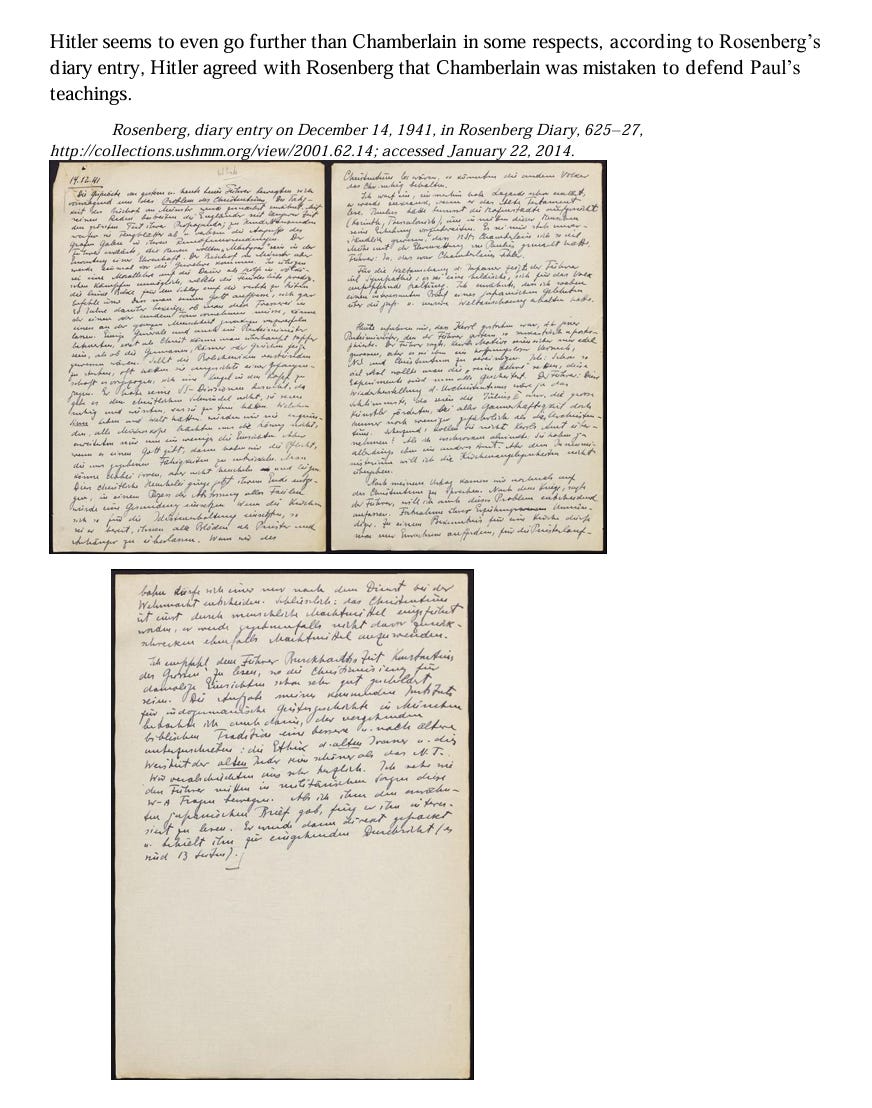
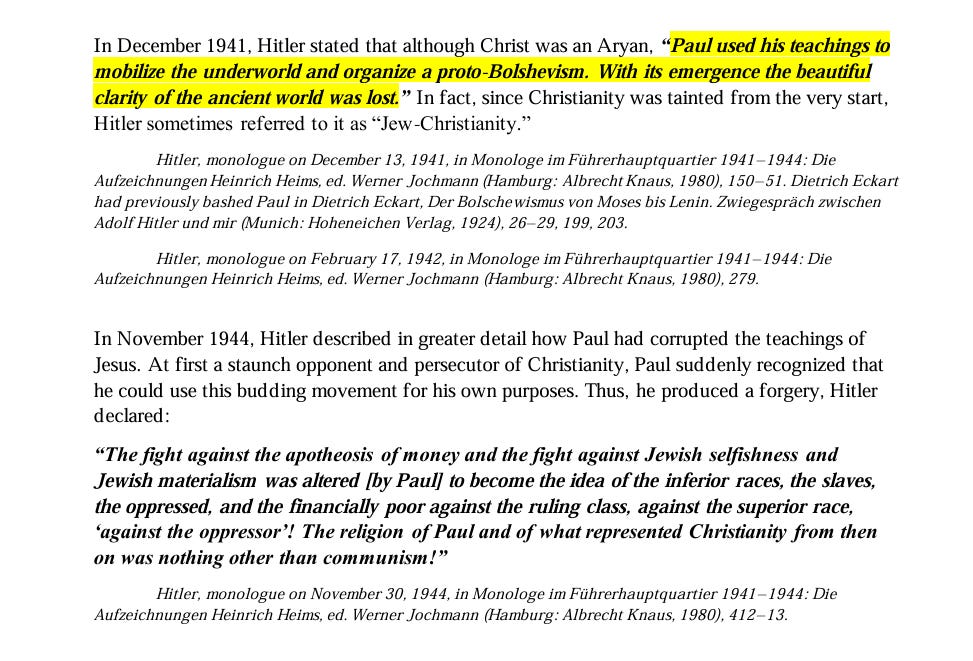
Confidential SS training file - the fight against the Church
"Peoples need no mediator; they need Führers! Christ the leader: that they understood."

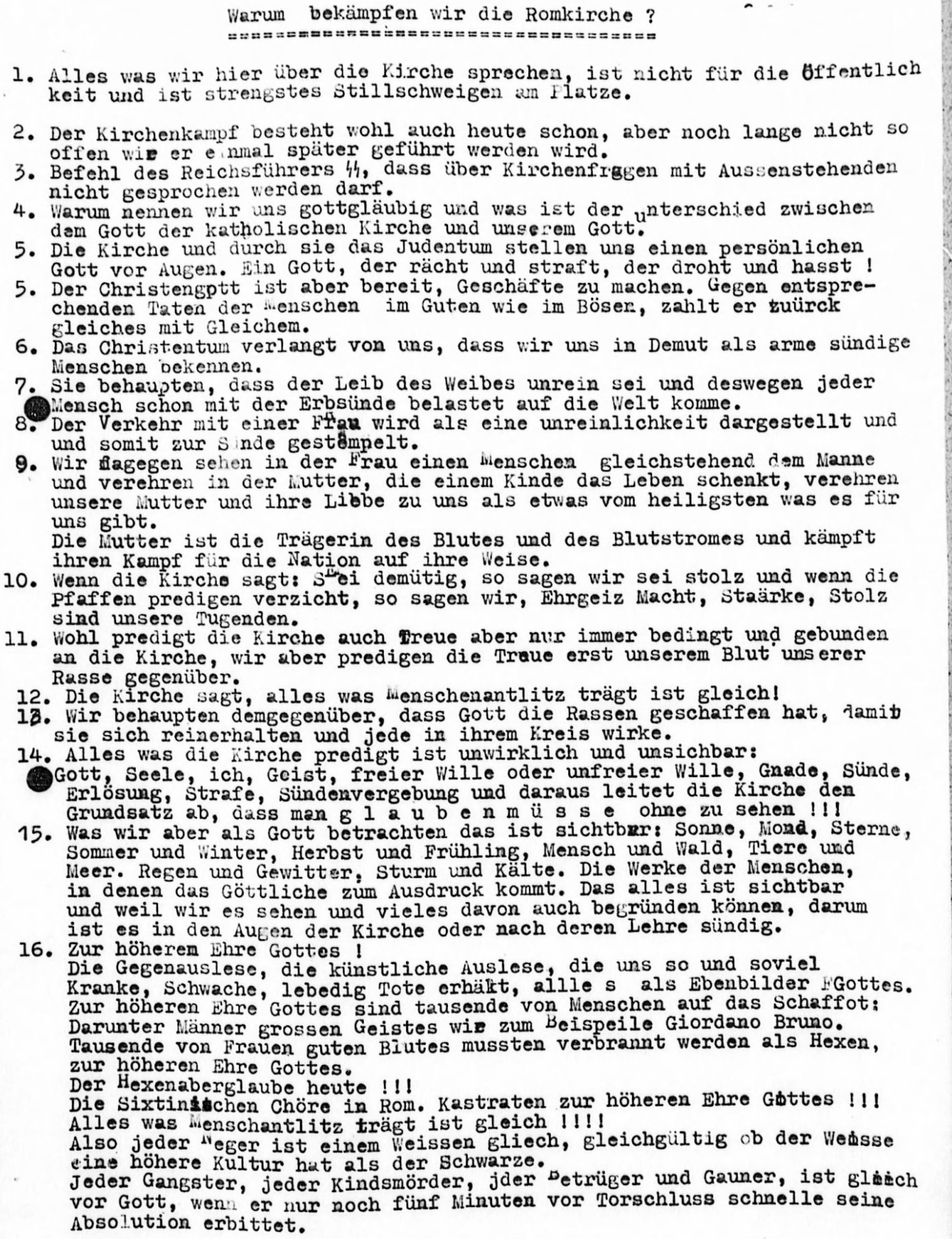
From the The German Federal Archives comes a document titled “Why are we fighting against the Church of Rome?” and containing an outline for an internal SS presentation regarding Nazi ideological opposition to Roman Catholicism as well as Christianity broadly. We believe the notes were written or supplied by Frau Dr. Kabusch, because the surrounding documents identify her as the lecturer for this training material and the pages in question continue the same anti-Christian/anti-Church lecture sequence, though the specific pages are unsigned.

Why are we fighting against the Church of Rome?
Everything we talk about the church here is not for the public and is strictly confidential.
The church struggle already exists today, but not nearly as openly as it will be conducted later.
Order from Reichsführer SS, that church issues may not be discussed with outsiders.
Why do we call ourselves deists (‘believers in a God’) and what is the difference between the God of the Catholic Church and our God.
The church and through it JUDAISM presents us with a personal God. A God who avenges and punishes, who threatens and hates! But the Christian God is ready to do to make deals. Against corresponding human actions, good or bad, he pays back with equal.
Christianity demands of us that we acknowledge ourselves in humility as poor, sinful human beings.
They claim that the woman’s body is unclean and that therefore every human being is born already burdened with original sin.
Intercourse with a woman is portrayed as an act of uncleanness and is therefore labeled as a sin.
We, on the other hand, see the woman as a human being equal to the man and venerate the mother who gives life to a child; we venerate our mothers and their love for us as one of the holiest things there is for us. The mother is the bearer of the blood and the bloodline, and (she) fights her fight for the nation in her own way.
When the church says: Be humble, we say be proud, and what the priests (specific derogative slur: ‘Pfaffe’) renounce in their preaching, we say, ambition, strength, and pride, are our virtues.
The church also preaches loyalty first, but only conditionally and bound to the church, but we preach loyalty to our blood, our race.
The Church says that everything bearing the human likeness (all who bear the human countenance) is/are equal!”
We maintain, on the other hand, that God created the races so that they could maintain their purity and that each should work within its own sphere.
Everything the church teaches is unreal and invisible: God, soul, self, spirit, free will or unfree will, mercy, sin, salvation, punishment, forgiveness of sin and from this the church derives the principle that one has to believe without seeing!
But what we consider to be God is visible: sun, moon, stars, summer and winter, autumn and spring, humans and forest, animals and sea, rain and thunderstorms, storm and cold. The works of men, in which the divine is expressed. All of this is visible and because we can see it and explain much of it, it is sinful in the eyes of the church or according to its teaching.
For the greater honor of God!
Counter-selection — the artificial selection that keeps alive for us so many sick, weak, living-dead people — all as images of God.
For the greater honor of God, thousands of people went to the scaffold; among them men of great intellect, such as Giordano Bruno. Thousands of women of good blood had to be burned as witches, for the greater honor of God.
The witch-superstition today!!!
The Sistine choirs in Rome. Castrati for the greater honor of God!!!
Everything that bears a human likeness is equal!!!
Thus every “Negro” is equal to a white person, regardless of whether the white person has a higher culture than the black. Every gangster, every child-murderer, every swindler and crook is equal before God, if only he quickly asks for his absolution five minutes before the final deadline.
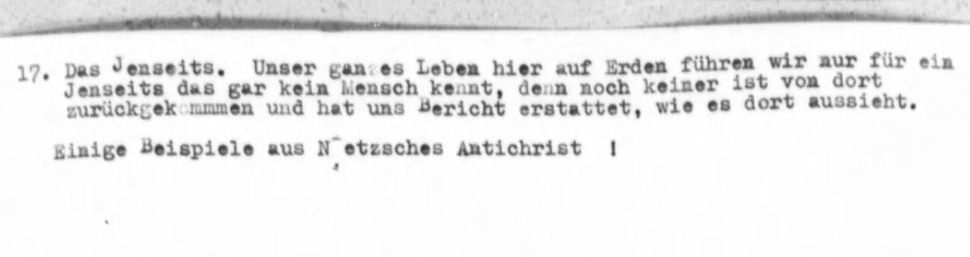
The Afterlife. We conduct our entire life here on earth only for an afterlife that no human being actually knows, because no one has yet come back from there and given us a report of what it looks like there.
Some examples from Nietzsche’s The Antichrist!
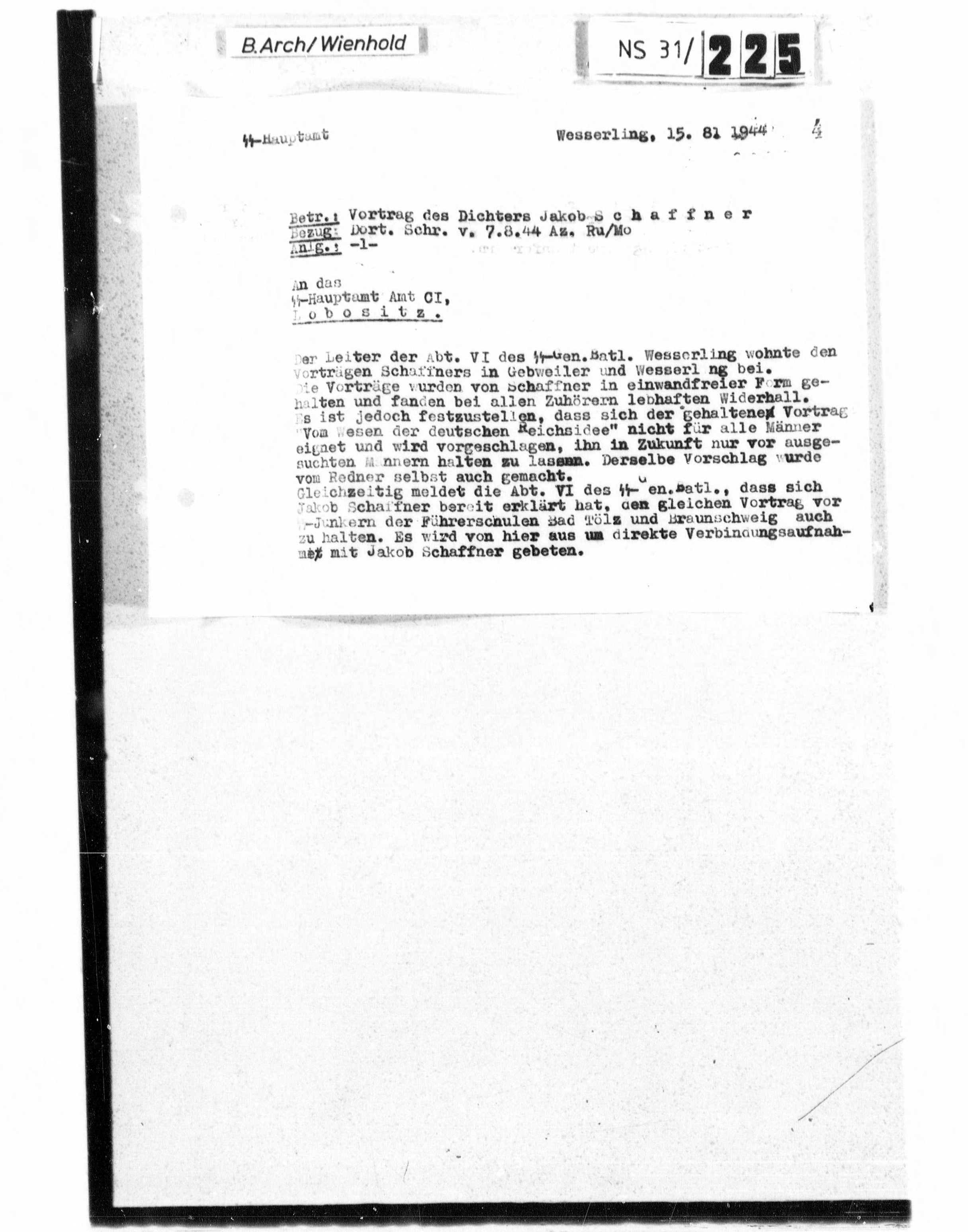
Within this same archival record, there is confirmation that SS troops were intentionally exposed selectively to varying levels of vehement ideological sentiment. In this example, a programmatic lecture by the anti-Christian writer Jakob Schaffner.
SS Main Office
Wesserling, 15 Aug. 1944
Subject: Lecture by the poet Jakob Schaffner
Reference: local letter of 7 Aug. 1944, file ref. Ru/Mo
Enclosure: -1-
To the
SS Main Office, Office CI,
Lobositz.
The head of Department VI of the SS Convalescents Battalion Wesserling attended the lectures by Schaffner in Gebweiler and Wesserling.
The lectures were delivered by Schaffner in flawless form and met with lively approval among all listeners.
It must, however, be stated that the lecture given by him, “On the Nature of the German Reich Idea,” is not suitable for all men and it is proposed in future to have him lecture only before selected men. The lecturer himself also made the same suggestion.
At the same time, the Department VI of the SS Convalescents Battalion reports that Jakob Schaffner has declared himself willing to give the same lecture before SS Junkers of the Leadership schools at Bad Tölz and Braunschweig.
It is therefore requested from here that direct contact be made with Jakob Schaffner.
This referenced lecture (Vom Wesen der deutschen Reichsidee) can be read here.
Here are a few notable excerpts:
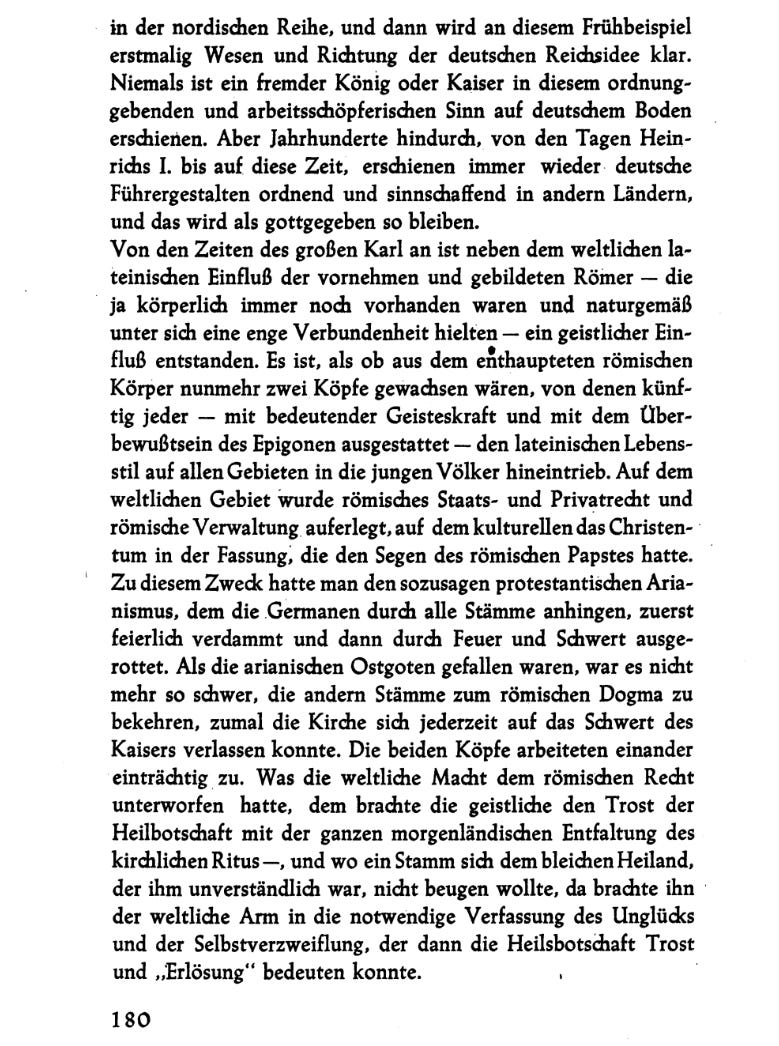
Page 180
He presents Orthodox/Roman (or orthodox non-Arian confessional Protestant) Christianity as something imposed on Germanic peoples and praises Arianism as the more “Germanic” alternative. Additionally, he depicts Christian conversion as immorally coercive psychological breaking, calls Christ the “pale Savior,” and puts “redemption” in quotation marks.
German:
Auf dem weltlichen Gebiet wurde römisches Staats- und Privatrecht und römische Verwaltung auferlegt, auf dem kulturellen das Christentum in der Fassung, die den Segen des römischen Papstes hatte. Zu diesem Zweck hatte man den sozusagen protestantischen Arianismus, dem die Germanen durch alle Stämme anhingen, zuerst feierlich verdammt und dann durch Feuer und Schwert ausgerottet.
English:
In the secular realm, Roman public and private law and Roman administration were imposed; in the cultural realm, Christianity in the version that had the blessing of the Roman pope. For this purpose, the so-called Protestant Arianism, to which the Germanic peoples of all tribes adhered, was first solemnly condemned and then exterminated by fire and sword.
German:
… und wo ein Stamm sich dem bleichen Heiland, der ihm unverständlich war, nicht beugen wollte, da brachte ihn der weltliche Arm in die notwendige Verfassung des Unglücks und der Selbstverzweiflung, der dann die Heilbotschaft Trost und „Erlösung“ bedeuten konnte.
English:
… and where a tribe would not bow to the pale Savior, who was incomprehensible to them, there the secular arm brought it into the necessary condition of misfortune and self-despair, in which the message of salvation could then mean comfort and “redemption.”
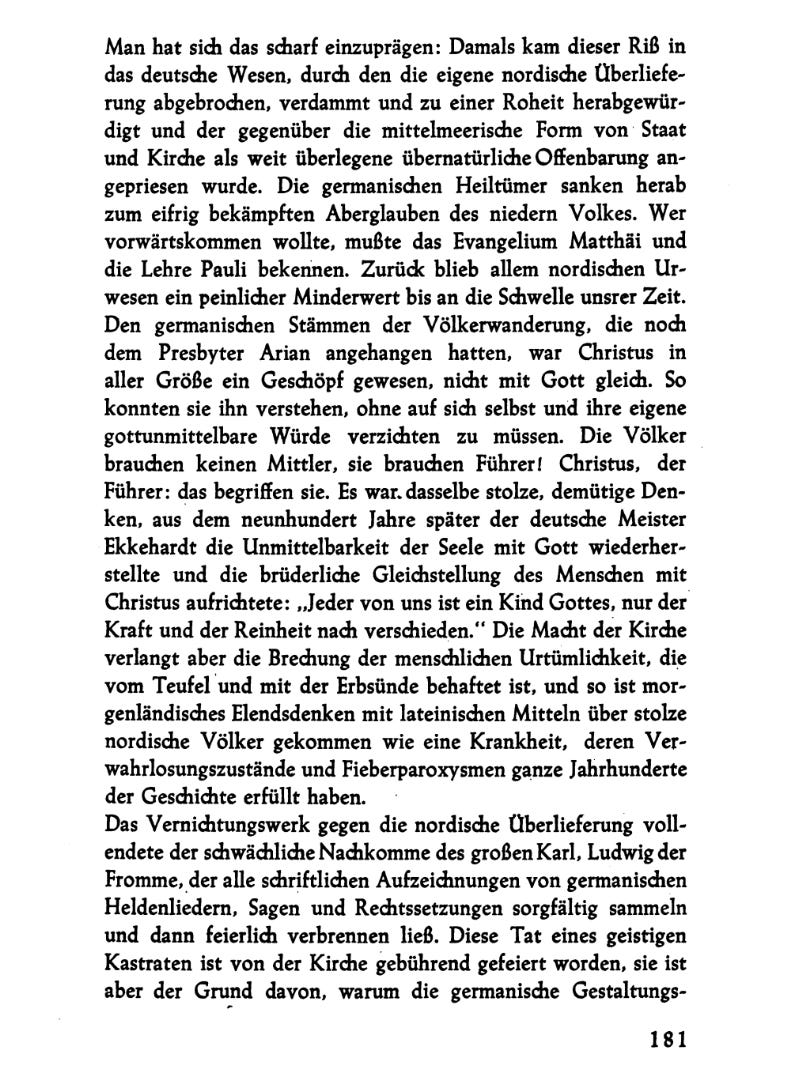
Page 181
He directly attacks New Testament Christianity, especially Matthew and Paul, as something that degraded “Nordic” identity. Schaffner rejects core Nicene Christianity: Christ’s equality with God and Christ as mediator. He remakes Christ into a racial-political “leader.” There is an attack on the doctrine of original sin, the devil, church authority, and the Christian view of fallen humanity as “misery-thinking” and a “disease.”
German:
Wer vorwärtskommen wollte, mußte das Evangelium Matthäi und die Lehre Pauli bekennen. Zurück blieb allem nordischen Urwesen ein peinlicher Minderwert bis an die Schwelle unsrer Zeit.
English:
Anyone who wished to advance had to profess the Gospel of Matthew and the teaching of Paul. An embarrassing inferiority remained attached to every Nordic primal essence down to the threshold of our own time.
German:
Den germanischen Stämmen der Völkerwanderung, die noch dem Presbyter Arian angehangen hatten, war Christus in aller Größe ein Geschöpf gewesen, nicht mit Gott gleich. So konnten sie ihn verstehen, ohne auf sich selbst und ihre eigene gottunmittelbare Würde verzichten zu müssen. Die Völker brauchen keinen Mittler, sie brauchen Führer! Christus, der Führer: das begriffen sie.
English:
For the Germanic tribes of the Migration Period who had still adhered to the presbyter Arius, Christ in all his greatness had been a created being, not equal with God. Thus they could understand him without having to renounce their own god-given dignity. Peoples need no mediator; they need leaders! (Führers!) Christ the leader (Führer): that they understood.
German:
Die Macht der Kirche verlangt aber die Brechung der menschlichen Urtümlichkeit, die vom Teufel und mit der Erbsünde behaftet ist, und so ist morgenländisches Elendsdenken mit lateinischen Mitteln über stolze nordische Völker gekommen wie eine Krankheit, deren Verwahrlosungszustände und Fieberparoxysmen ganze Jahrhunderte der Geschichte erfüllt haben.
English:
But the power of the church demands the breaking of human primality, which is afflicted by the devil and by original sin; and so oriental misery-thinking came, by Latin means, over proud Nordic peoples like a disease, whose states of neglect and feverish paroxysms filled whole centuries of history.
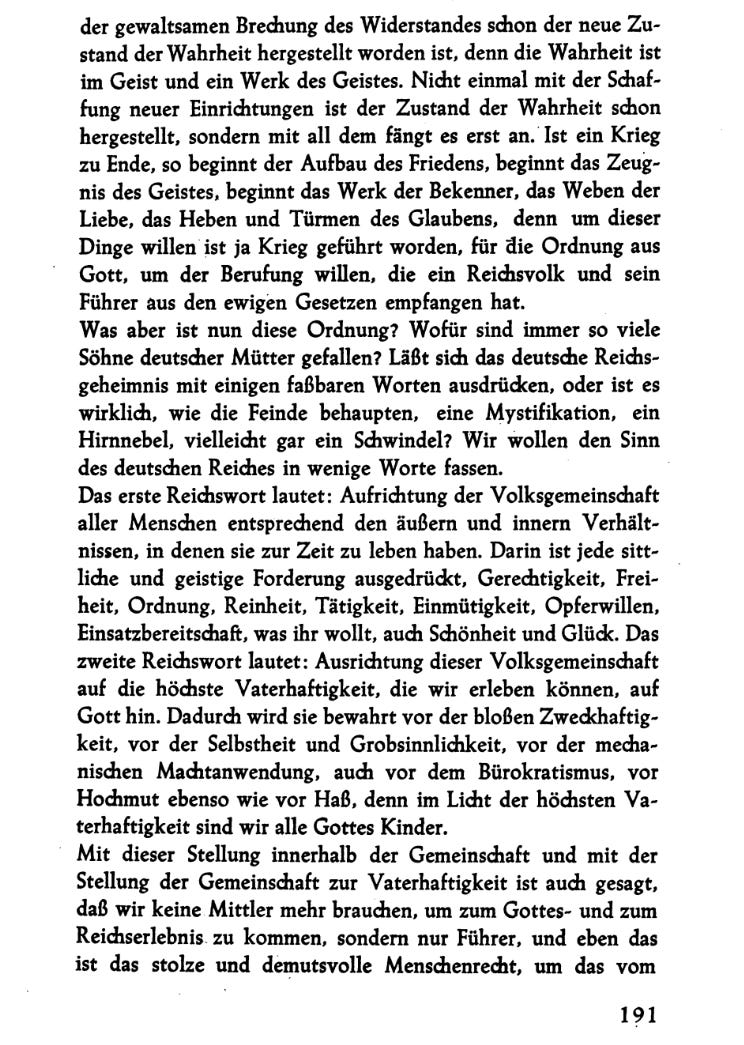
Page 191
He rejects priestly mediation and, by implication, the Christian doctrine of Christ as mediator. It replaces mediation with Führer-principle spirituality.
German:
Mit dieser Stellung innerhalb der Gemeinschaft und mit der Stellung der Gemeinschaft zur Vaterhaftigkeit ist auch gesagt, daß wir keine Mittler mehr brauchen, um zum Gottes- und zum Reichserlebnis zu kommen, sondern nur Führer…
English:
With this position within the community, and with the position of the community toward fatherliness, it is also said that we need no mediators in order to come to the experience of God and of the Reich, only (a/the) Führer…
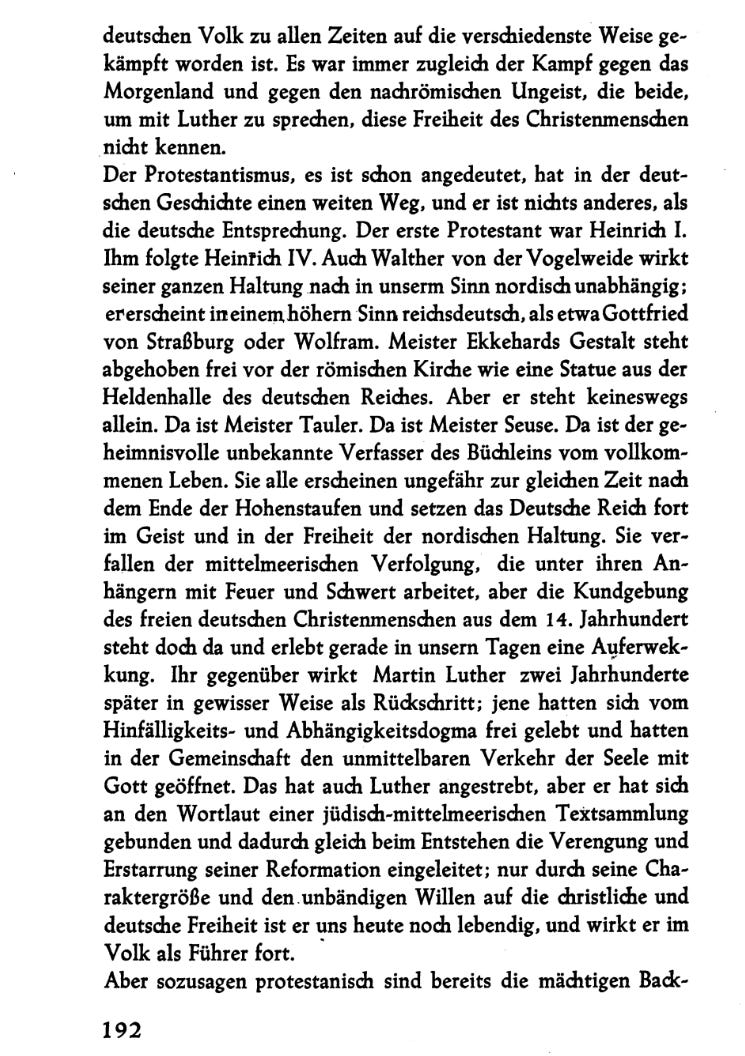
Page 192
While attacking Protestant biblical Christianity, he criticizes Luther for binding the Reformation to Scripture, and dismisses the Bible as a “Jewish-Mediterranean collection of texts.”
German:
Luther hat auch angestrebt, aber er hat sich an den Wortlaut einer jüdisch-mittelmeerischen Textsammlung gebunden und dadurch gleich beim Entstehen die Verengung und Erstarrung seiner Reformation eingeleitet…
English:
Luther also strove for that, but he bound himself to the wording of a Jewish-Mediterranean collection of texts and thereby, just as it emerged, introduced the narrowing and hardening of his Reformation…
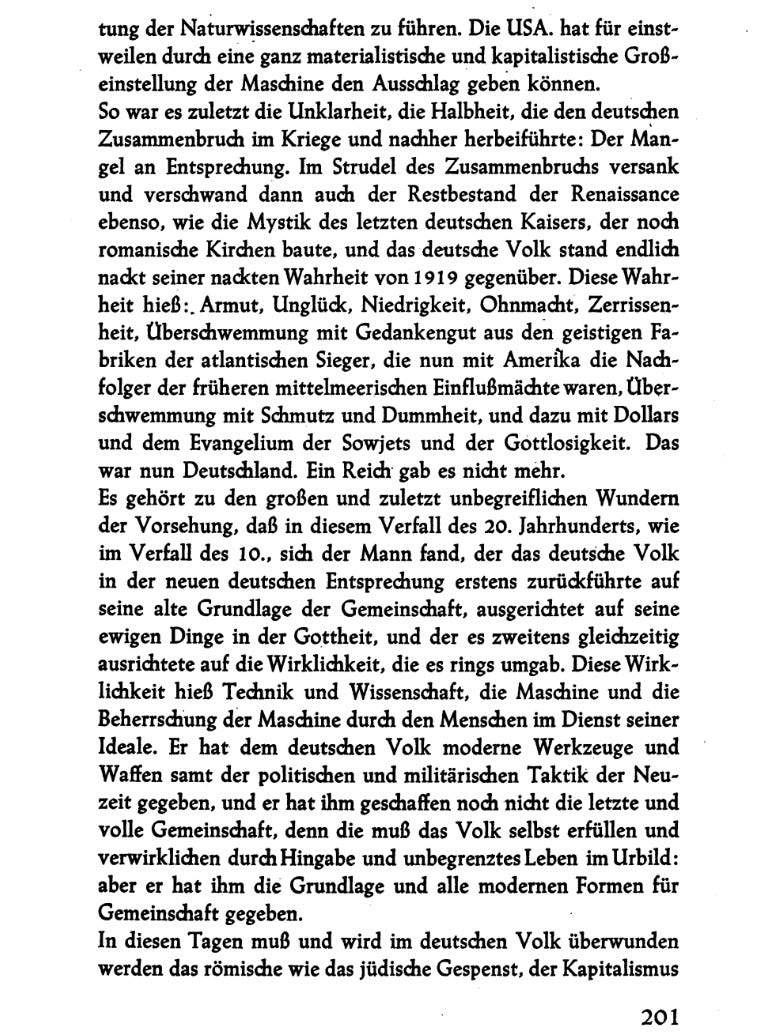
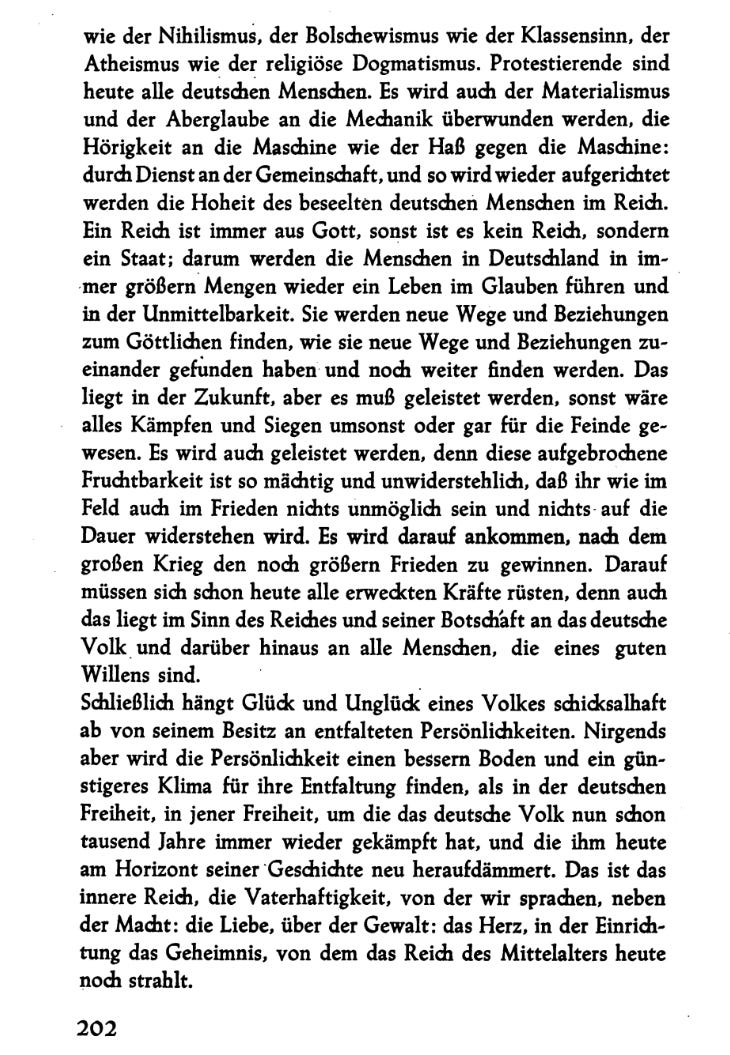
Pages 201–202
He places “religious dogmatism” alongside ideological enemies to be overcome, and frames both “Roman” and “Jewish” inheritances as hostile specters. In context, that includes Roman Christianity and biblical/Jewish roots of Christianity.
German:
In diesen Tagen muß und wird im deutschen Volk überwunden werden das römische wie das jüdische Gespenst, der Kapitalismus wie der Nihilismus, der Bolschewismus wie der Klassensinn, der Atheismus wie der religiöse Dogmatismus.
English:
In these days there must and will be overcome in the German people both the Roman and the Jewish specter, capitalism as well as nihilism, Bolshevism as well as class-consciousness, atheism as well as religious dogmatism.
In Jakob Schaffner’s semi-autobiographical (it’s his biography but told as a character named Johannes) book Johannes (1922) he states that Christ’s death may have moved, shaken, and exalted him emotionally, but it never made him feel redeemed. He also argues that a truly divine redemption should not still depend on faith or end in a new judgment, and he describes Pauline predestination to salvation or damnation as a sharp “Pauline dissonance” within Christianity.
German:
English:
A third architectural coupling was necessary between the redemptive death on the cross of the Redeemer, who sacrificed himself out of the immeasurable impulse of love, and the Last Judgment, which led over into the eternal victory of light and divinity. Through Christian teaching, Christ’s act of love had now, in essence, brought a new serpent’s apple into the world — only with the opposite effect. Because the first human beings ate the fruit of knowledge, they were lost. But human beings after Christ are lost and are judged insofar as they do not know — namely, through faith. A redemption, if it is truly a redemption by supernatural, divine power, ought no longer to be dependent on a means such as faith, and ought not to lead to any new judgment. Personally, I have not, for a single moment in all my life, felt myself redeemed by Christ’s death. Moved, shaken, gripped in the depths and raised up to great human heights — yes! But never redeemed!
Then there was the cutting Pauline dissonance, only a few years after Christ’s death, that one is predestined both to blessedness and to damnation — a doctrine that had been especially important and precious to Herr Vater. This wing of the Christian edifice required the boldest and most heartfelt acts of overcoming. It demanded all the love and magnanimity that even the Church Fathers, in their lives and martyrdom, had still owed to humanity. I had moments full of feeling and vision in which the vaulting of this three-aisled cathedral came together for me without contradiction, but also without words, so that my soul could wander reverently down and up the long vistas of Creation, the Fall, and Redemption, while through the colored windows the radiant splendor of the Thousand-Year Reich shone in, and in the light-glow of the altar the Ineffable guarded its mysteries.
This Pauline component also ideologically connects with Hitler’s own beliefs on the matter.